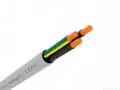
The core distinction between flame-retardant power cables and standard cables lies in their combustion characteristics during a fire: flame-retardant cables can self-extinguish once the ignition source is removed, preventing the fire from spreading along the cable run. In contrast, standard cables will continue to burn until consumed. The two types also differ significantly in terms of materials, labeling, and application scenarios.
Key Differences in Combustion Performance
Flame-Retardant Power Cables: Under national standard test conditions, the spread of flames is strictly limited. Once the ignition source is removed, any residual flames will self-extinguish within a specified timeframe, preventing the fire from propagating along the entire length of the cable.
Standard Cables: These have not undergone special flame-retardant treatment. Once ignited by an open flame, they will continue to burn, allowing the fire to spread rapidly along the cable line and effectively acting as a conduit for the fire to propagate.
Differences in Materials and Construction
Flame-Retardant Power Cables: The insulation layers, sheaths, filler cords, and wrapping tapes are all made from flame-retardant polymers. Some high-end models utilize "low-smoke, halogen-free" (LSZH) materials, which absorb heat during thermal decomposition and release water vapor to dilute oxygen, thereby interrupting the chain reaction of combustion.
Standard Cables: These use only conventional insulation and sheath materials, such as polyvinyl chloride (PVC) or polyethylene (PE). They contain no flame-retardant additives and lack any specialized flame-retardant protective layers in their construction.
Differences in Labeling and Standards
Flame-Retardant Power Cables: The cable surface is marked with "ZR" or specific flame-retardant grades—"ZA," "ZB," or "ZC" (with Grade A offering the highest level of flame retardancy). These cables comply with the current national standard, GB/T 19666-2019; the older "ZR" designation is gradually being replaced by these graded labels.
Standard Cables: The surface markings include only basic information such as voltage rating, cross-sectional area, and the manufacturer's name. There are no flame-retardancy-related markings; these cables meet only basic insulation standards and carry no specific flame-retardant certifications.
Differences in Application Scenarios
Flame-retardant power cables: These must be used in environments with a high risk of fire or high population density—such as high-rise buildings, subway tunnels, industrial and mining facilities, data centers, and new energy storage projects. They are a mandatory requirement for modern, high-standard engineering and construction projects.
Standard (non-flame-retardant) cables: These are suitable only for low-risk, open environments involving general electrical equipment—for example, standard lighting circuits in residential or commercial buildings, or simple power distribution setups in areas free of combustible materials.