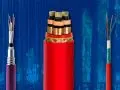
In the vast network of power systems, welding cables, though not core components, are
indispensable, acting like the "current arteries." They carry the welding current, ensuring
stable arc combustion, and are the lifeline connecting the welding machine to the
workpiece during welding operations. From construction sites to manufacturing
workshops,from ship decks to energy pipelines, every efficient transmission of
welding current silently supports the precise operation of modern industry.
I. The Physiological Function of the Current Arteries: The Core Role
of Welding Cables
The core function of welding cables is to conduct welding current, forming a closed circuit
to ignite the arc. This process is like the arteries in the human body transporting blood; the
current flows through the cable from the welding machine to the workpiece, driving the
melting and fusion of the metal. Its importance is reflected in three aspects:
Energy Guarantee: Reducing current transmission losses, avoiding insufficient welding
energy due to voltage drop, and ensuring welding quality.
Safety Protection: Preventing electric shock, short circuits, and mechanical damage
through insulation layers and sheath design, protecting the safety of operators.
Efficiency Improvement: Stable current transmission shortens welding time and improves
production efficiency, especially significant in batch operations.
II. The Resilience and Endurance of the Arteries: Technical
Characteristics of Welding Cables
To adapt to complex working conditions, welding cables need to possess multiple
characteristics:
High Conductivity: Using a multi-strand fine copper wire stranded structure to reduce
resistance, minimize heat loss, and ensure efficient current transmission.
High Temperature Resistance: The insulation layer withstands the high temperatures
during welding (up to 200°C or more), preventing melting or aging and extending
service life.
Abrasion and Tensile Resistance: The sheath material has resistance to mechanical wear
and bending fatigue, adapting to frequently moving working environments, such as robotic
welding on automotive production lines.
Flexibility: Easy to bend and coil, reducing the burden on welders and improving flexibility,
especially crucial in confined spaces.
Environmental Adaptability: Oil-resistant, acid and alkali resistant, and UV resistant,
suitable for outdoor, humid, or corrosive environments, such as the salt spray environment
in shipbuilding.
III. The Footprints of the Arteries: Application Scenarios of Welding
Cables
The "current artery" function of welding cables spans multiple industrial fields:
Construction Industry: Used for steel structure welding, such as on-site splicing of high
-rise building frames. The weather resistance of the cables ensures safety during outdoor
operations.
Manufacturing Industry: In automotive production lines, the flexibility and wear resistance
of the cables support frequent robot movements, improving assembly efficiency.
Shipbuilding and Offshore Engineering: Salt-mist corrosion-resistant cables are used for
hull welding, adapting to humid environments and ensuring long-term reliability.
Energy Sector: On-site welding of wind turbine towers and oil pipelines relies on the high
load capacity and continuous operation of the cables, avoiding overheating risks.
Conclusion: The Evolution and Future of the Arteries
As the "current arteries" in power systems, the performance of welding cables directly
affects welding quality and industrial safety. With the development of Industry 4.0, cables
are evolving towards lightweight, intelligent, and environmentally friendly designs, such as
integrating temperature sensors for real-time overheating warnings or using halogen-free
sheaths to reduce fire toxicity. These innovations will continue to support the precise needs
of modern manufacturing, making these "current arteries" beat even stronger.