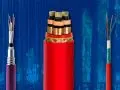
Armored Cables: The Robust Guardians of Power Transmission
In the fields of power, communication, and industrial control, cables serve as the "blood
vessels" for energy and signal transmission, making their safety and reliability paramount.
Armored cables, with their unique structural design, provide extra protection to the internal
conductors in complex or harsh environments, becoming a core component of modern
infrastructure construction.
I. Definition and Core Value of Armored Cables
Armored cables are special cables that have a layer of metal or non-metallic armor
wrapped around the cable core, designed to enhance mechanical strength, resistance
to external impact, and environmental adaptability. Their design stems from addressing
the vulnerabilities of traditional cables to physical damage, chemical corrosion, or
electromagnetic interference. Through "armor-like" protection, they significantly
extend service life and reduce maintenance costs. For example, in mines or chemical
plants, the armor layer can withstand rock pressure and acid-base corrosion, ensuring
stable power transmission.
II. Outstanding Features of Armored Cables
The "armor" of armored cables gives them several advantages:
High mechanical strength: Resists external impact, compression, and tension, preventing
damage to internal conductors, suitable for direct burial underground or high-voltage
environments.
Excellent interference resistance: The metal armor layer (such as steel tape) effectively
shields against electromagnetic interference, ensuring stable signal transmission,
suitable for communication systems.
Superior environmental resistance: Resistant to corrosion, moisture, and high
temperatures, performing reliably in chemical zones, underwater, or extreme climates.
Enhanced safety: Prevents damage from rodents or accidental cutting, reducing the risk
of leakage and short circuits, enhancing public safety.
III. Wide Range of Application Scenarios for Armored Cables
The protective characteristics of armored cables make them an ideal choice for specific
environments:
Power systems: In urban power grids, substations, and factory power supply, steel tape
armored cables (such as VV22) are used for low-voltage fixed laying, while steel wire
armored models (such as YJV32) are suitable for high-voltage underground burial,
withstanding soil pressure. Industry and Mining: In areas susceptible to mechanical
damage, such as underground mines, the armored layer protects against rock
impacts, and steel wire armored cables support vertical laying, preventing the
risk of breakage.
Public Buildings and Communications: Flame-retardant armored cables (such as ZR-VV22)
are used in places with high fire safety requirements, and communication cables (such as
HYA53) provide interference-resistant signal transmission along roads or in residential
areas.
New Energy and Marine Engineering: In wind power, solar energy projects, and submarine
cables, the armored design withstands high temperatures, low temperatures, or strong
radiation environments.
Armored cables, like "armor," protect the lifelines of modern energy and information
transmission. From urban power grids to deep-sea engineering, their structural
innovation and performance advantages make them reliable guardians in harsh
environments. With technological advancements, armored cables will continue to
evolve, providing stronger support for smart grids and green energy.