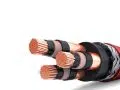
In modern construction, power communication, and other fields, cables serve as the "blood
vessels" of energy and information transmission, and their fire resistance directly impacts
the safety of life and property. Flame-retardant and fire-resistant cables are two core
members of the fire-resistant cable family. Although both bear the name "fire-resistant,"
they differ fundamentally in their fire-resistant mechanisms, structural characteristics,
and application scenarios. Clarifying these differences is crucial for scientific selection and
building a safety defense.
I. Different Fire-Resistant Mechanisms
The essential difference between flame-retardant and fire-resistant cables lies in their
drastically different fire-resistant objectives. The core mission of flame-retardant cables is
to "prevent the spread of fire," acting as an "isolation" in a fire. This is achieved by adding
flame retardants to the insulation layer, sheath, and filling materials, creating a chemical
flame-retardant barrier.
Fire-resistant cables, on the other hand, are positioned as "lifelines" in a fire, aiming to "
continuously supply power in flames." Their core technology lies in their physical heat-
resistant structure, specifically by wrapping multiple layers of fire-resistant mica tape
around the conductor. This silicate mineral retains it sinsulating properties even at 1000℃.
Even if the outer insulation layer is burned away, the ceramicized structure formed by
the mica tape maintains the insulation between conductors and the integrity of the
circuit, ensuring that critical equipment can continue to operate normally for a period
of time during a fire.
II. Structural Characteristics: Differences in Materials and Processes
Structurally, flame-retardant cables and fire-resistant cables have different design
emphases. Flame-retardant cables emphasize the consistency of flame-retardant
properties in materials. Their typical structure includes: a high-purity oxygen-free
copper conductor, a cross-linked polyethylene (XLPE) or polyvinyl chloride (PVC)
insulation layer with added flame retardants, a low-smoke halogen-free flame-
retardant polyolefin sheath, and some products also feature a steel tape armor layer
to enhance mechanical protection.
Fire-resistant cables, on the other hand, add a core fire-resistant layer to the ordinary cable
structure. raditional fire-resistant cables employ a double-layer mica tape overlapping
Twrapping process, with an overlap rate of no less than 30%, forming a dense, high-
temperature resistant insulation layer. Some high-end models also feature a copper tube
longitudinal sheath, utilizing the thermal shielding effect of metal to reduce the internal
temperature by 200-300℃, further enhancing fire resistance. Mineral-insulated fire-
resistant cables are more specialized, composed entirely of inorganic materials
magnesium oxide and copper, offering the most outstanding fire resistance, but their
manufacturing process is complex and their price is higher.
III. Application Scenarios: Each Has Its Own Role, Irreplaceable
Based on performance differences, flame-retardant cables and fire-resistant cables have
clearly defined application scenarios. Flame-retardant cables are suitable for densely
populated areas and general power istribution systems, such as general lighting and
power lines in shopping malls, office buildings, and residential communities, as well as
dareas like subway tunnels and data centers. Their function is to prevent the spread
of fire through cables, reduce secondary disasters, and buy time for personnel
evacuation and initial firefighting.
Fire-resistant cables are the "last line of defense" in critical emergency systems and must
be used in circuits that require continuous operation during a fire, such as power supply
circuits for fire pumps, fire-resistant roller shutters, smoke exhaust fans, and other fire-
fighting equipment; emergency lighting, evacuation guidance, alarm systems; and
locations with extremely high requirements for power continuity, such as hospital
operating rooms, subway tunnels, and nuclear power plants. A power outage in
these locations will directly threaten lives or cause significant property damage.
IV. Clarifying Common Misconceptions: Flame Retardant ≠ Fire Resistant, Do Not Use Them Indiscriminately
In practical applications, flame-retardant cables and fire-resistant cables are often
confused, and the resulting safety hazards cannot be ignored. The most common
misconception is that "flame-retardant cables can replace fire-resistant cables." In
fact, their functions are completely different: flame-retardant cables can only prevent
the spread of fire; they themselves will burn in a fire and cannot guarantee power
supply. While fire-resistant cables can provide continuous power in flames, they do not
possess flame-retardant properties themselves, and without flame-retardant measures,
they may become a carrier for the spread of fire.
Another misconception is blindly pursuing high fire resistance levels, such as using Class A
fire-resistant cables in ordinary office areas, resulting in wasted costs. A scientific selection
strategy should be "scenario determines needs": low-smoke halogen-free flame-retardant
cables should be given priority for conventional building wiring to reduce the hazards of
toxic fumes during fires; fire-resistant cables must be used for critical circuits such as fire
protection systems; if both flame-retardant and fire-resistant requirements need to be
met, "flame-retardant + fire-resistant" dual-function cables or mineral-insulated cables
can be selected.